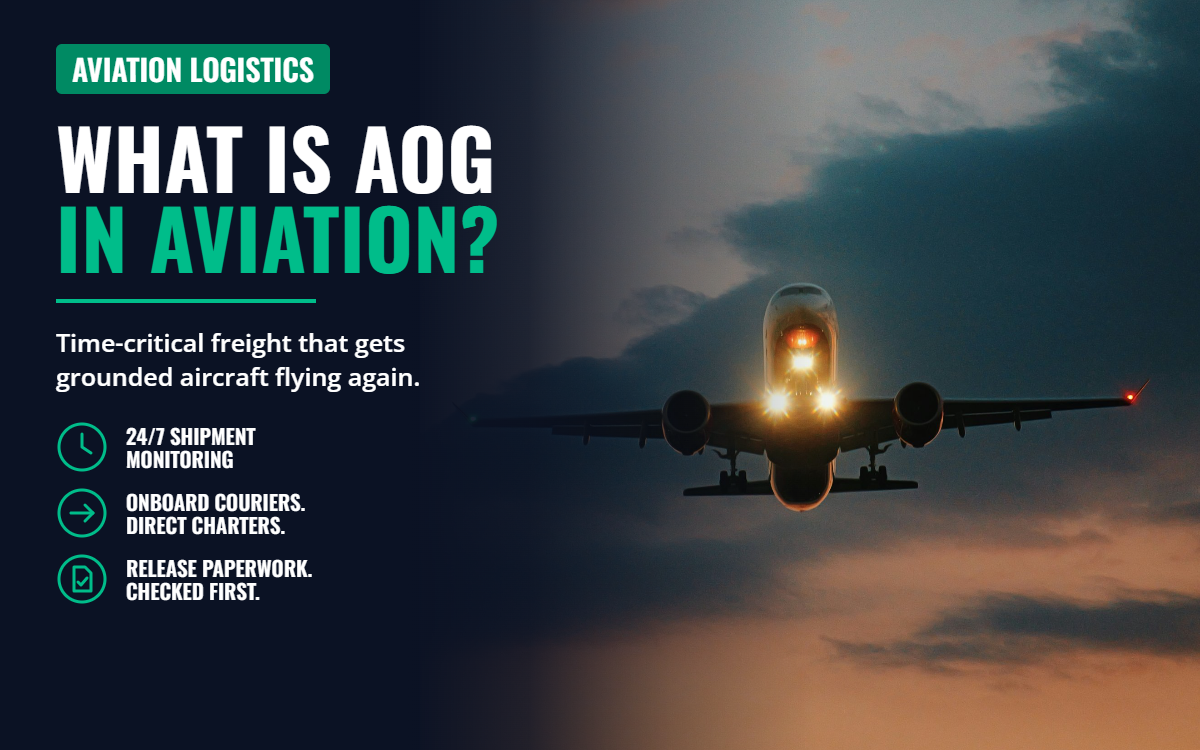
When an aircraft is grounded waiting on a single replacement part, every minute counts. The stress of unexpected downtime, tight maintenance windows, and complex international trade rules can quickly overwhelm your operations.
Whether you manage charter flights, support commercial maintenance schedules, or own private aircraft, you need transport partners who understand the pressure you face. This guide walks you through the essentials of aviation logistics, helping you keep your aircraft airborne and your supply routes moving without delay.
What is aviation logistics and why does it matter to your fleet?
If you are asking what is aviation logistics, it simply comes down to the organised movement of aircraft parts, tools, and technical equipment wherever they are needed across the world. It includes everything from flying out a replacement turbine for an unscheduled repair to delivering precision navigation avionics for planned servicing.
Every flight schedule relies on hundreds of components moving across borders without friction. When newcomers ask our team what is aviation logistics, we explain that it is far more than standard shipping. It requires dedicated route planning, strict temperature and shock monitoring, and direct coordination with air traffic, apron handlers, and customs authorities.
A single delayed sensor can cancel flights, disrupt passenger itineraries, and trigger costly compensation claims. Having reliable aviation logistics gives your team the confidence that when a component leaves the warehouse, it will reach your engineers on schedule.
How do you handle an Aircraft on Ground (AOG) emergency?
An Aircraft on Ground emergency is the ultimate test of any supply chain. When a plane cannot take off, every passing hour brings mounting hangar fees, passenger rebooking costs, and lost revenue.
In these high-pressure moments, standard courier services are rarely fast enough. You need specialised aviation logistics solutions designed specifically for rapid, round-the-clock intervention.
Our team approaches an AOG scenario with a three-pronged response strategy:
- Dedicated collection: A local courier collects the part within minutes of your call, bypassing standard sorting hubs.
- Next flight out or onboard courier: For smaller, high-value components, an onboard specialist carries the item directly on commercial flights to clear customs by hand.
- Airside delivery: Pre-cleared security transport takes the component straight onto the tarmac or directly into your maintenance hangar.
When an emergency strikes, clear communication between your dispatchers and logistics operators is vital. Even basic errors, like a typo on an air waybill, can leave an engineer waiting on an empty ramp.
Which aviation logistics solutions keep your routine maintenance on track?
Not every flight part is an emergency, but planned maintenance checks require just as much precision. If your team is running a scheduled C-check or D-check, you must coordinate hundreds of replacement parts from different worldwide suppliers to arrive simultaneously.
Choosing the right aviation logistics solutions for planned maintenance allows you to stage equipment efficiently. Staggered arrivals tie up valuable hangar space and leave your certified mechanics sitting idle waiting on missing fasteners.
Here are the key factors you should review when planning routine deliveries:
- Consolidation points: Grouping non-critical parts at regional hubs to minimise landing and handling fees.
- Reverse logistics: Setting up clear collection paths for repairable components, core returns, and leased testing equipment.
- Inventory tracking: Using live monitoring so your maintenance planning team knows the exact location of every crate before taking an engine offline.
Keeping your maintenance bay supplied on a predictable schedule prevents small component shortages from spiralling into major delays.
How do you move dangerous goods, engines, and oversized parts safely?
Aircraft components present unique physical challenges that standard freight carriers are rarely equipped to handle. From massive jet engines and wing flaps to chemical oxygen generators and lithium-ion avionics batteries, safety rules are extraordinarily strict.
Dangerous goods demand complete compliance with International Air Transport Association (IATA) regulations. Even simple items like aircraft paints, sealants, and fire extinguishers require specialised hazard labelling, certified packaging, and authorised carrier approval.
Oversized freight, such as an engine stand or a landing gear assembly, requires dedicated road trailers, air ride suspension, and heavy-duty crane arrangements. What we often see is that improper weight distribution or missing tie-down points cause minor transit abrasions that lead to instant part rejection by certified quality inspectors.
Working with partners experienced in reliable aviation logistics ensures your oversized and hazardous shipments meet every single civil aviation standard before they leave the factory floor.
Navigating international customs and trade compliance without delays
Moving parts across borders is often where logistics plans hit unexpected obstacles. International customs checks can hold up a shipment for days if paperwork contains minor discrepancies in part numbers or valuation declarations.
To keep international shipments moving smoothly, you should keep the following essentials in mind:
- Accurate tariff classifications: Ensure every component has the correct commodity code to avoid border holds and penalty fees.
- Temporary import procedures: Use mechanisms like ATA Carnets when moving specialist tools or test equipment that will return home after repairs.
- Clear end-use statements: Explicitly declare civilian aircraft use to clear export controls and bypass unnecessary trade restrictions.
In our experience, dealing with post-Brexit customs procedures or sudden clearance backlogs at major UK transit hubs requires proactive document verification long before the freight plane touches down.
Our Expert Take: Getting It Right
Getting aviation transport right requires meticulous attention to the smallest operational details. Here are a few insider tips our experts recommend to safeguard your high-value aviation shipments:
- Protect avionics against hidden static shock: Always package sensitive electronics in silver Faraday shielding bags, not standard pink anti-static bubble wrap. Add fresh desiccant packs inside the barrier bag to prevent internal condensation when your cargo moves from freezing cargo holds to humid tarmac environments.
- Match part serials to paperwork before the truck leaves: Quality inspectors will ground a part immediately if the physical serial number on the data plate does not mirror the EASA Form 1 or FAA 8130-3 tag exactly. Have your warehouse crew cross-check every digit on the physical part against the shipping manifest prior to collection.
- Calculate dry ice sublimation rates for temperature-sensitive sealants: Certain aerospace potting compounds and composite pre-pregs must stay below minus forty degrees Celsius. Calculate your dry ice levels based on possible flight delays and customs holds, adding at least forty-eight hours of extra sublimation margin.
- Cushion engine stands with calibrated shock sensors: Do not rely solely on driver assurances when moving jet engines. Fit visible, tamper-evident shock and tilt indicators directly to the engine cradle so receiving engineers can verify transit integrity before signing the delivery slip.
Taking these precautions eliminates unpleasant surprises and keeps your maintenance line running without friction.
Common Questions About Aviation Logistics
What makes aviation transport different from standard freight shipping?
Aviation transport operates under strict civil aviation regulations, requiring certified traceability for every component. Shipments often involve hazardous goods, oversized parts, or time-critical AOG deadlines that require direct airside access and continuous monitoring.
How quickly can an emergency aircraft part be delivered?
Emergency deliveries can often be initiated within sixty minutes of your booking. Depending on the global destination, components are routed via the next commercial flight out, dedicated air charter, or accompanied by an onboard courier to arrive the very same day.
What paperwork is required to ship an aircraft component internationally?
You will typically need a standard commercial invoice, a detailed air waybill, and an authorised release certificate such as an EASA Form 1 or FAA 8130-3 tag. Additional hazardous goods declarations or ATA Carnets may also be required depending on the nature of the cargo.
Why is shock and temperature monitoring necessary during transit?
Delicate flight computers, turbine blades, and composite materials can suffer hidden structural fatigue if subjected to rough handling or temperature extremes. Continuous monitoring proves the part remained within certified manufacturer tolerances throughout its entire journey.
Partner with Scanlon Freight for Your Aviation Needs
Keeping aircraft airborne requires rapid thinking, meticulous planning, and a logistics partner who shares your urgency. At Scanlon Freight, our team takes total control of urgent, high-value, and complex shipments so your maintenance engineers never have to wait on empty promises.
Whether you need emergency AOG assistance on the other side of the world or dependable routine freight for your fleet, we are ready to support your operations around the clock. Contact us today to discuss your transport requirements and discover how our dedicated specialists can keep your fleet moving forward.